











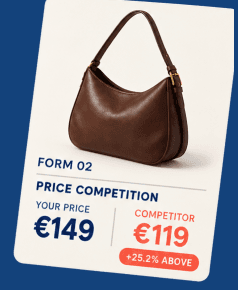
See where you lose on price, product by product.
Price War compares your price with the competitors you choose, for every matched product. Each product is marked best, same or more expensive, with the cheapest competitor named, and the result goes into your feed.
Your price, their price, for every matched product.
A product with a weak score often has a simple reason: someone else sells it cheaper. Shoppers compare, and ad platforms show your product next to theirs. Price War makes that visible before you pay for the click.
Feedance matches your products to the same items sold by the competitors you choose, compares the prices and keeps the result current in your feed.
- Best, same or more expensive, for every matched product
- The competitor with the lowest price, named
- Written into your feed as a label every channel can read
- Usable in Feedance rules and filters, next to Product Score and 4T
In one catalog, 44% of matched products were cheaper elsewhere.
Every matched product gets one of three positions. In a 38,010-product fashion catalog, almost half of the matched products were sold cheaper by at least one competitor.
Figures from one fashion catalog analysed in Feedance. Your own results will differ.
- Best price52.7%of matched productsCheaper than every matched competitor.
price_position = "best" - Same price3.5%of matched productsEqual to the lowest competitor price.
price_position = "same" - More expensive43.8%of matched productsAt least one competitor sells it cheaper.
price_position = "more_expensive"
Know exactly who undercuts you.
Choose the competitors that matter in your market. For every matched product, Feedance shows where you stand against each of them and names the cheapest one, so your team knows which price to look at.
Push where your price wins. Pull back where it loses.
Price position becomes most useful next to the other signals. A Toxic product that is also more expensive is a pricing problem, not a creative one.
Feedance does not change your prices, bids or budgets. It labels every product so your pricing team and your campaigns can act on the same facts.
- Best pricePushGive these products priority. A campaign or product set built on price_position = "best" sends spend where shoppers already see your best offer.
- Same priceWin on the adPrice will not set you apart, so the creative has to. Show delivery, campaign and price badges with Creative Suite.
- More expensivePull back or fixTake them out of prospecting, review the price, or keep them in a low-priority group until the gap closes.
Price position travels with the product.
The position and the cheapest competitor are written into your feed as attributes and custom labels, ready for Google, Meta, TikTok and 200+ channels.
- Google: split listing groups or asset groups by custom label
- Meta and TikTok: build product sets from price position
- Combine with segment_4t and product_score in one rule
- Matched products only; unmatched products keep their other labels
Price is one reason a product loses. Missing sizes is the other.
A shopper who clicks a sneaker and finds only one size left will not buy, however good the price. Broken Size flags styles whose size run is mostly out of stock, so campaigns can leave them out before the click is wasted.
Explore Broken SizeSpend where you can win the sale.
Vivense lifted ROAS by 32% by not advertising products it could not sell. Note Cosmetics increased ROAS by 127% while spending 10% less.
Read the Vivense story



Questions about Price War
Need more detail? Read the full FAQ.
What is Price War?
Price War compares your price with the competitors you choose, for every matched product. Each product is marked best price, same price or more expensive, the cheapest competitor is named, and the result is written into your feed.
Which competitors are compared?
The competitors you choose during setup, the ones that matter in your market. You can add more later; each label names the cheapest one.
What does “44% cheaper elsewhere” mean?
In one 38,010-product fashion catalog analysed in Feedance, 43.8% of the matched products were sold cheaper by at least one competitor. Your own share will differ.
What happens to products without a match?
Only matched products get a price position. Unmatched products keep their other labels and are exported as before.
Does Feedance change my prices?
No. Price War labels the position. Any price change stays your pricing team’s decision.
Does Feedance manage my bids or budgets?
No. Your campaigns and ad platforms keep control of both. The label tells them where your price wins and where it loses.
How are products matched to competitors?
By identifiers such as GTIN, together with brand and title, so the same item is compared across sites.