













Since 13 December 2024, every online offer of a consumer product in the EU has to show four things: who made it, who answers for it inside the EU, how to identify it, and which warnings come with it. That is Article 19 of the General Product Safety Regulation (Regulation (EU) 2023/988). Each channel collects those four things differently. eBay accepts up to 5 EU responsible persons, 2 safety pictograms and 8 safety statements per listing. Amazon, Allegro and TikTok Shop want a reference to a contact you registered beforehand. Google and Meta have no GPSR field at all.
This playbook is for feed managers and agencies who sell into the EU from outside it, Turkish and Gulf brands especially, and for anyone whose marketplace listings are being blocked over missing safety data. By the end you will have one compliance data model in your source feed, a mapping to each channel's field names, and validation rules that stop incomplete rows before a marketplace does. It is a data playbook, not legal advice.
What GPSR requires a product listing to show
Article 19 says the offer must "clearly and visibly indicate" at least:
- The manufacturer: name, registered trade name or trade mark, plus a postal address and an electronic address.
- The responsible person, if the manufacturer is not established in the EU: name, postal address and electronic address.
- Product identification: a picture, the type, and any other product identifier.
- Warnings and safety information that go on the product, its packaging or an accompanying document, in a language consumers in the selling Member State easily understand.
The Commission's 2025 business guidelines say an electronic address "can be an e-mail address or dedicated section of your website that enables consumers to contact you directly", and that "a website is not in itself sufficient". A homepage URL in the contact field does not count.
Marketplaces carry a duty of their own. Article 22(9) obliges them to build an interface that lets traders supply this information and shows it on the listing. That is why eBay, Allegro and others added mandatory fields, and why a feed with gaps now gets offers blocked instead of just collecting warnings.
One correction to a figure many blogs repeat: the adopted regulation does not set fines at "up to 4% of turnover". Article 44 leaves penalties to each Member State, requiring only that they be "effective, proportionate and dissuasive".
Step 1: Decide who the manufacturer and the responsible person are, per brand
Under GPSR, the manufacturer is whoever markets the product under their own name or trade mark. That is the brand owner, not the factory. Work through each brand you sell:
- The brand owner is established in the EU. Send the manufacturer's details only. No responsible person is needed.
- The brand owner is outside the EU (Turkey, the UAE, China, the UK). Send the manufacturer and an EU-established responsible person: an importer, an authorised representative with a written mandate, or a fulfilment service provider. Turkey's customs union with the EU does not make a Turkish company an EU economic operator for this purpose.
- You resell other brands. The manufacturer is still the brand on the label. Get the contacts from your supplier, and do not guess them from a brand's website.
Turkey has its own version of this rule. Since 1 April 2025, Turkey's distance-sales market surveillance regulation (Official Gazette, 30 October 2024) requires Turkish listings to show the seller's details. They must also show the Turkey-based manufacturer, or the importer if the manufacturer is abroad, each with a postal and an e-mail address, plus warnings in Turkish. If you sell in both markets, put both sets of contacts in one data model.
Step 2: Keep a contact table keyed by brand, not by product
Contact details are per brand. Repeating them on every product row means 40,000 copies of an address that changes once a year. Build a small lookup table instead and join it to the feed:
| Column | Example value (illustrative) | Rule |
|---|---|---|
brand | Ornek Mum | Must match the feed's brand exactly |
mfr_name | Örnek Mum Sanayi A.Ş. | Legal or registered trade name |
mfr_address | OSB 5. Cadde No:12, 16140 Nilüfer, Bursa, TR | Street, postcode, city and country all present |
mfr_email | safety@ornekmum.example | Monitored inbox, not a homepage |
mfr_country | TR | ISO 3166-1 alpha-2 |
eu_rp_name | RP Berlin GmbH | Required when mfr_country is not an EU member |
eu_rp_address | Musterstraße 1, 10115 Berlin, DE | Must be inside the EU |
eu_rp_email | gpsr@rpberlin.example | Same email you register on Amazon and TikTok |
tr_importer_* | empty here | Only for foreign brands sold in Turkey |
This also matches how the channels work. Zalando collects manufacturer and responsible-person data at brand level. Amazon, Allegro and TikTok Shop register contacts once and refer to them from each listing.
Step 3: Add the product-level fields to your source feed
Three things really do vary by product: the identifier, the safety text, and any safety documents. Add them as custom columns in the source feed, or in a supplementary feed so the master data stays clean. A scented-candle row from the illustrative Turkish brand above:
id: OM-CND-220 | brand: Ornek Mum | mpn: CND-220-LAV | gtin: 8680000000006 | safety_warning_en: Never leave a burning candle unattended. Burn within sight. Keep away from things that catch fire. Keep out of reach of children and pets. | safety_warning_de: Brennende Kerzen nie unbeaufsichtigt lassen. … | safety_doc_url: https://ornekmum.example/docs/cnd-220-safety.pdf
Two decisions matter here. First, store warnings per language. Article 19(d) ties the language to the Member State where you sell, so a German offer needs German text and a Polish offer needs Polish. Second, the warning text has to match what is printed on the product or its packaging. Zalando states this outright, and it is the safe reading everywhere else.
Step 4: Map the fields to each channel
This is where most feeds break. Field names, structure and enforcement differ by channel:
| Channel | Manufacturer | EU responsible person | Safety information | What happens without it |
|---|---|---|---|---|
| eBay (Inventory API, on the offer) | regulatory.manufacturer (companyName max 100 chars, address, email) | regulatory.responsiblePersons[], max 5, type EUResponsiblePerson | productSafety.pictograms (max 2), statements (max 8), documents | Listings "may not be visible or purchasable" in the EU and Northern Ireland (eBay) |
| Amazon (Listings Items API / JSON feed) | gpsr_manufacturer_reference.gpsr_manufacturer_email_address (ASIN level) | dsa_responsible_party_address (SKU level) | compliance_media or gpsr_safety_attestation | Account Health lists offers that must be made compliant (Amazon) |
| Allegro (product-offers API) | productSet[].responsibleProducer (ID or name) | productSet[].responsiblePerson, if the manufacturer is outside the EU | safetyInformation: TEXT (up to 5,000 chars), ATTACHMENTS or NO_SAFETY_INFORMATION | Mandatory since 13 Dec 2024 (Allegro) |
| TikTok Shop EU | manufacturer_ids | responsible_person_ids | Category attribute for regulatory marking or label | Product edits fail without valid IDs (TikTok Shop) |
| Kaufland | GPSR Contacts API, per EAN or manufacturer (since Sep 2026) | Same API, by contact type | safety_guidelines, safety_data_sheet | Offers "systematically excluded from selling" (Kaufland) |
| bol | Manufacturer name, address and electronic address | Responsible economic operator | Per category | Mandatory since 5 Mar and 1 Apr 2026 (bol) |
The pattern to notice: eBay takes the full contact in the listing, while Amazon, Allegro, TikTok and now Kaufland take a pointer. On Amazon, the email values must match contacts you have already entered in Seller Central or Vendor Central. Register contacts first, then send listings. The other order fails.
Step 5: Handle Google Shopping and Meta catalogs
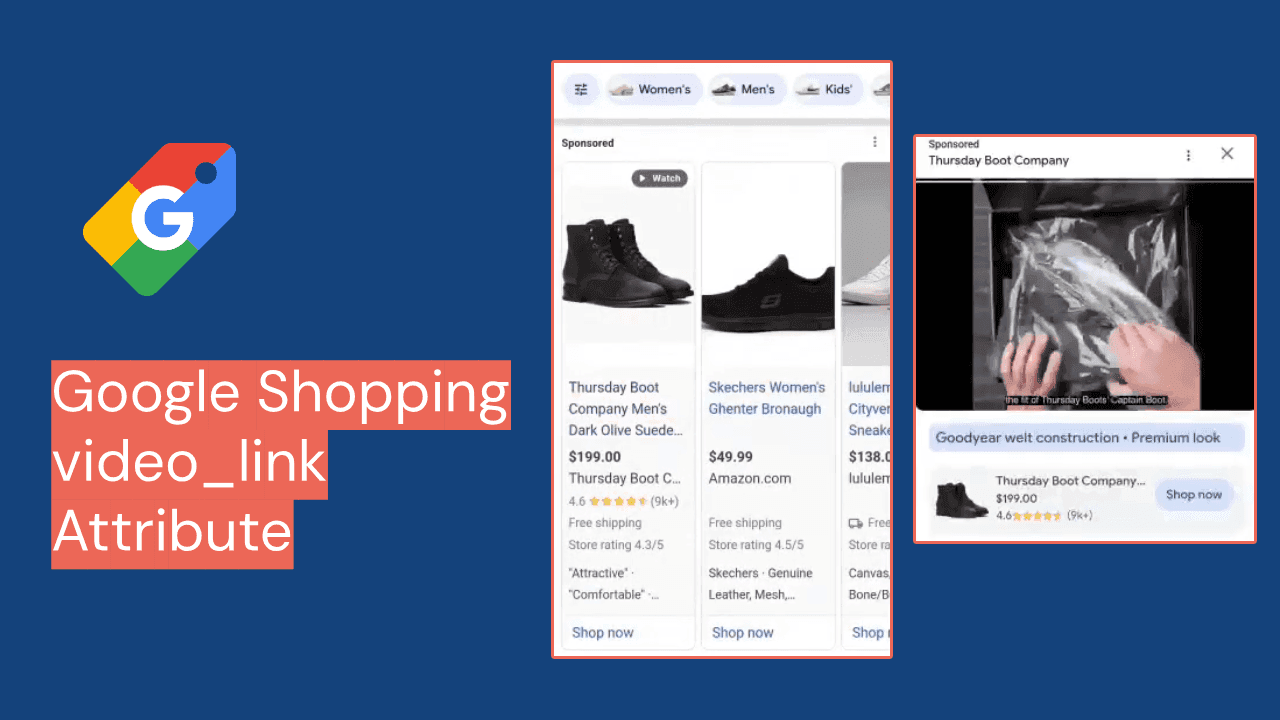
We checked Google's product data specification and its compliance help pages. As of today there is no manufacturer-contact, responsible-person or safety-warning attribute. Meta's catalog fields include manufacturer_info, but Meta describes it as required for Shops, and its importer fields are for selling in India. None of them is presented as a GPSR field.
Our reading: on these channels, the purchase happens on your website, so the Article 19 information has to sit on the landing page. That page is the offer. The Commission has not said whether an ad or a comparison listing counts as an offer in its own right, so do not count on that question being settled. In practice, render the same brand contact table and warning fields on every product page, and the shopping feed needs nothing extra.
Step 6: Validate before every push
Run these as blocking rules in your feed tool rather than one-off audits. Score one point for each rule that holds across your whole EU feed:
- Every row's
brandjoins to a row in the contact table. - Every manufacturer has a street, postcode, city, country and email.
- Every non-EU manufacturer has at least one EU-located responsible person. eBay rejects listings where neither the manufacturer nor a responsible person is in the EU (error 21920429).
- No electronic address is a bare homepage URL.
- Warnings exist in the language of each target market, or the category has been confirmed as needing none.
- Every safety document URL resolves to a public PDF. Amazon rejects Google Drive and Dropbox links.
- Amazon and TikTok reference emails match the contacts registered in Seller Central or Seller Center exactly.
- Updates never send empty GPSR columns. eBay's export guide warns that empty fields in bulk templates delete the stored values.
- Every Allegro offer sets
safetyInformationto TEXT, ATTACHMENTS or NO_SAFETY_INFORMATION, never leaving it empty. - A product-count alert fires when the number of offers accepted by a marketplace drops after a push.
Score 10 of 10 before you scale a market. At 7 or below, expect blocked offers.
Where this playbook breaks down
It covers the information a listing must show. It does not cover the rest of GPSR: risk assessments, technical documentation, recalls, or the Safety Business Gateway. It also does not cover sector rules (toys, cosmetics, electrical goods) that add their own labelling, CE marking and documentation. The legal interpretation, especially who your responsible person should be, belongs with a compliance adviser.
The Commission's guidance does not say whether a Shopping ad, a comparison-site listing or a social post is itself an offer under Article 19. Treat our landing-page approach as a sensible default, not settled law.
If most of your EU revenue comes from marketplaces, a marketplace integrator with order sync, such as ChannelEngine, or Channable's marketplace connectors, will usually handle registered-contact IDs and listing errors more directly than a feed tool built around ad channels. Use the contact model above either way. It carries over to any tool.
Frequently asked questions
Does GPSR apply to sellers based outside the EU?
Yes, if the offer targets EU consumers. The Commission's guidelines treat an online offer as made available in the EU when the seller directs its activities to one or more Member States, for example through language or delivery options. A non-EU manufacturer then needs an EU-established responsible person on the listing.
Is a Turkish manufacturer covered by the customs union exemption?
No. The responsible person must be established in the EU, and a company in Turkey is not. Turkish brands selling to EU consumers need an EU importer, authorised representative or fulfilment service provider named as the responsible person.
Can I use a contact form instead of an email address?
For the EU, the Commission accepts an email address or a dedicated website section that allows direct contact, but not a static website. Turkey's regulation specifically asks for an e-mail address, so keep a real inbox in your data either way.
Do Google Shopping feeds need GPSR attributes?
Google has no GPSR attribute in its product data specification. The information belongs on your product landing page, which is where the purchase happens. Check the specification again whenever Google updates it.
In which language do safety warnings have to be?
In a language consumers in the Member State of sale can easily understand, as that Member State decides. In practice this means one warning field per target market language, matching what is printed on the product.
What is the fine for missing GPSR data?
The regulation does not set one. Article 44 leaves penalties to each Member State. The practical risk most sellers hit first is marketplace enforcement: hidden, blocked or excluded offers.
Do products listed before 13 December 2024 need GPSR data?
Marketplaces apply the requirement to live offers as well. Zalando applies brand-level data to all live articles, and bol began taking existing products offline from 1 April 2026 when manufacturer data was missing. Plan to backfill your whole EU catalog.
Next step
If your catalog is spread across several sources and markets, the hard part is keeping one brand contact table joined to every channel's field names on every sync. Book a 15-minute Feedance demo and we will map your EU feed's GPSR fields on your own catalog.
Related reading: how to set the condition attribute under Turkey's refurbished goods rules, the feed rules and supplementary feeds used in Step 3, Feed Protection for the blocking checks in Step 6, and the 200+ channels a single feed can reach.
Sources
- Regulation (EU) 2023/988 (GPSR), Articles 19, 22(9), 44, 52
- European Commission, Guidelines on the application of the EU general product safety legislative framework by businesses, C/2025/6233
- Uzaktan İletişim Araçları Yoluyla Piyasaya Arz Edilen Ürünlerin Piyasa Gözetimi ve Denetimi Yönetmeliği, Article 6
- eBay Seller Center, General Product Safety Regulation
- eBay export guide, GPSR bulk templates
- eBay Inventory API, ResponsiblePerson type
- eBay Trading API, ProductSafetyType (pictogram and statement limits)
- eBay Trading API release notes (error 21920429)
- Amazon SP-API, GPSR attributes in Listings Items API and JSON feeds
- Allegro developer news, responsible producers and persons
- Allegro developer news, safety information as text
- TikTok Shop Partner API, Create Responsible Person
- Kaufland Seller API release log (GPSR Contacts API, v2.44.0)
- Kaufland Global Marketplace, GPSR
- bol developers, manufacturer data and responsible economic operator
- Zalando Partner University, GPSR data requirements
- Google Merchant Center, product data specification
- Meta, catalog fields reference

Kardelen Yılmaz works on growth at Feedance, where she helps e-commerce brands and agencies get more return from every product they advertise. She writes about product feed quality, Shopping and Performance Max campaigns, creative automation, and how AI-driven shopping is changing product visibility.
LinkedIn