












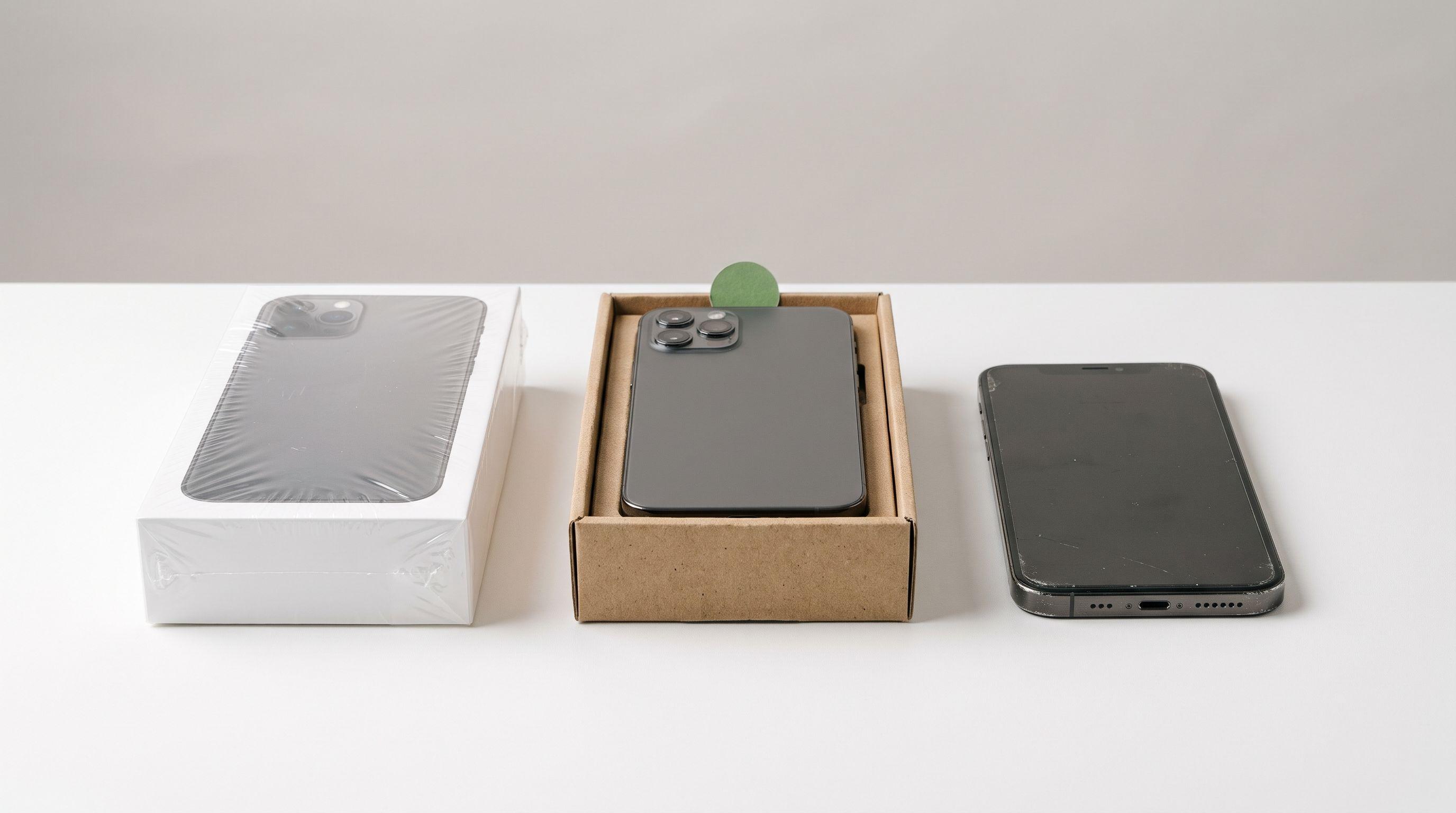
A refurbished phone, an open-box pair of headphones and a used camera look similar in a product database. In a feed they are three different promises, and every channel reads them differently. Google requires condition on every used and refurbished item and disapproves products that get it wrong. Meta marks the field as required for every catalog item. In Turkey, the rules changed on 1 August 2026, when a new refurbished goods regulation took effect for a market where the Ministry of Trade says about 1,574,000 products have been refurbished since January 2022, with 25 authorised refurbishment centres operating.
This reference is for e-commerce teams and agencies that sell second-hand, open-box, outlet or refurbished stock. By the end you will be able to assign the right value to each edge case, set identifiers and titles to match, decide when a Turkish listing may say "yenilenmiş" at all, and score your feed against a ten-point checklist.
The three condition values and what each channel means by them
Google and Meta accept the same three values: new, refurbished and used. The values must be in English. Google says so in its policy on compatible and refurbished products. That catches Turkish and Arabic feeds where a platform export writes yeni, ikinci el or yenilenmiş straight into the column.
| Value | Google definition | Google status | Meta status |
|---|---|---|---|
new | Never used, in original packaging, not opened | Optional | Required field, one of three values |
refurbished | Professionally restored to working order so it appears new, and comes with a warranty | Required for each refurbished item | Required field, one of three values |
used | Second-hand, or modified from the original condition as sold by the manufacturer | Required for each used item | Required field, one of three values |
The Google definitions come from the condition attribute page. Meta's catalog fields reference lists condition among the fields that can stop a product from uploading if missing or badly formatted. So a feed that leaves new blank can still work on Google but fail on Meta. Our rule is simple: always send a value, including new.
Two details matter at the campaign level. Google's condition page notes that used and refurbished products are not shown on YouTube organic and Discover surfaces, although they can still serve as ads on YouTube, Display and Gmail. Vehicle ads support only new and used, so a refurbished vehicle value is not an option.
Which value an edge case belongs to
Most errors happen in the grey zone between new and used. The test that settles almost every case is in Google's definitions. new requires unopened original packaging. refurbished requires professional restoration and a warranty. Anything else is used.
| Stock type | Value | Why |
|---|---|---|
| Open-box return, never used, packaging opened | used | Google's refurbished policy puts products with opened or missing packaging under used |
| Store display or demo unit | used | It is no longer unopened, and it has not been professionally restored |
| Outlet or end-of-line stock, sealed | new | Price and season do not change condition, only packaging and use do |
| Device restored by a certified refurbisher with a warranty | refurbished | Meets both tests. In Turkey, also check the next sections |
| Device checked and cleaned by the seller, no warranty | used | Without a warranty Google's refurbished definition is not met |
| Refilled printer cartridge, third-party ink in an OEM shell | used | Google requires condition used and a title starting with "refilled" |
| Vintage or signed collectible | used | Google's own example lists a signed, displayed hat as used, even at a price above new |
How identifiers, titles and images change with condition
Condition is not a standalone field. Google ties brand, GTIN, MPN, title and image rules to it in the compatible and refurbished products policy, and products that break them can be disapproved or the account suspended.
Identifiers
- A product refurbished with OEM parts only keeps the OEM's brand, GTIN and MPN, with
conditionset torefurbished. Google's example lists a new and a refurbished Chromecast as two separate items sharing one GTIN. - If any third-party part went in, use the third party's brand, GTIN and MPN, not the OEM's.
- For refilled third-party cartridges with no third-party GTIN, set
identifier_existstofalse.
Titles
- Third-party refurbished items must start with a non-OEM keyword such as "Refurbished" or "Remanufactured", or with the refurbisher's name.
- OEM names and model numbers can appear later in the title, but not at the start, and words like "original" or "genuine" are not allowed.
- Google's own examples add "Refurbished" to the title of OEM refurbished items too. We treat that as the default for every refurbished row.
Images
Refurbished products must be shown alone or in third-party packaging, never in OEM packaging. Reusing the manufacturer's press shot breaks this rule.
Turkey: when a listing may say "yenilenmiş" at all
Turkey regulates the word "refurbished" itself for a defined list of electronics. The Yenilenmiş Ürünler Hakkında Yönetmelik was published in the Official Gazette on 27 June 2026 (issue 33293). It took effect on 1 August 2026 and replaced the 2020 regulation.
- Scope. Per the regulation summary and press coverage on publication day, the annex covers mobile phones, tablets, smartwatches, laptops and desktops, game consoles and modems, with televisions newly added.
- Who may refurbish. A refurbished product is a used good sold after refurbishment by a refurbishment centre or its authorised seller (Article 3). A centre needs a Ministry authorisation certificate valid for five years (Articles 5 and 7) and at least TRY 100 million paid-in capital (Article 6).
- What listings must show. Article 4/3 requires packaging, labels, advertisements and listings to show the word "yenilenmiş" and the refurbishment centre's details so that consumers can easily notice them. Refurbished goods must also be sold in a category kept separate from new and second-hand goods.
- Price differences. If the same refurbished product group is sold at different prices, Article 4/8 requires the physical and technical differences behind the price to be disclosed before payment.
- Consumer terms. The summary sets a warranty of at least one year from delivery and a 14-day right of withdrawal without reason, in stores as well as online.
The practical reading for a feed: in a Turkish feed, a product in an annex category is refurbished only if it came through an authorised centre. Everything else in those categories is used, however good its state. The earlier regime already banned advertising non-compliant goods in a way that creates a refurbished impression. A Google or Meta ad with "Refurbished" in the title is an advertisement, so the same discipline applies to it. Outside the annex categories, such as a restored vacuum cleaner, Google's definition is the operative test.
We are not lawyers. This section summarises the published text and its summary, and anything you build on it should be checked with Turkish counsel.
The EU angle: warranty periods for used goods
Google's refurbished definition requires a warranty, but it sets no length. In the EU, Article 10 of Directive 2019/771 gives a two-year seller liability period. It also lets member states allow a shorter agreed period for second-hand goods, but never less than one year. If a pan-European feed carries used stock, the description should state the warranty or liability term that applies in that market.
Worked feed rows
These rows are illustrative, built for this guide rather than taken from a client feed. Each shows the source value an e-commerce platform typically exports and the value that should reach the channel.
| Source row | Sent to Google and Meta |
|---|---|
title: iPhone 13 128GB Yenilenmişcondition: yenilenmişsupplier: ABC Yenileme Merkezi (authorised) | title: Refurbished iPhone 13 128GB, ABC Yenileme Merkezicondition: refurbishedbrand: Apple, OEM GTIN kept |
title: iPhone 12 64GB Temiz İkinci Elcondition: yenilenmişsupplier: individual trade-in, no centre | title: Used iPhone 12 64GBcondition: used |
title: Kablosuz Kulaklık X200tag: açık-kutucondition: (empty) | title: Kablosuz Kulaklık X200 (Open Box)condition: used |
title: Kahve Makinesi K5 Outlettag: outlet, sealedcondition: (empty) | condition: new |
The second row is the expensive mistake. The source system calls the item "yenilenmiş" because it was cleaned and tested, but no authorised centre was involved. Sending it as refurbished breaks Google's warranty test and, in Turkey, the regulation's labelling rule.
In practice we derive condition with if-then feed rules rather than trusting the platform column. Map tags such as açık-kutu, teşhir, ikinci-el and open-box to used. Allow refurbished only when a supplier field matches your list of authorised centres. Default everything else to new. The same rule should prepend "Refurbished" or "Used" to the title.
One more thing can undo correct values. Google's automatic item updates can change condition when it detects a mismatch with your landing page, as we covered in our guide to stopping Google from overriding feed data. If the product page says "like new" and the feed says used, decide which one is true and fix the other.
Ten-point condition checklist with scoring
Score one point per item that holds for 100% of affected rows. Nine or ten is safe to scale. Seven or eight needs fixing before peak season. Six or below means stop adding second-hand stock to ads until it is fixed.
- Every row sends a
conditionvalue, includingnew, so Meta never blocks the upload. - Values are only
new,refurbishedorused, in English, lowercase. - Open-box, display and demo units are
used. - Every
refurbishedrow carries a stated warranty in the description. - In Turkey,
refurbishedin annex categories is limited to authorised-centre stock, and the centre is named in the title or description. - Refurbished and used titles start with "Refurbished", "Used" or the refurbisher's name, and never say "original" or "genuine".
- Images show no OEM packaging on refurbished items.
- OEM GTINs are used only where all parts are OEM, otherwise third-party identifiers or
identifier_existsfalse. - New and second-hand versions of one model are separate items with separate IDs and prices.
- Landing pages show the same condition as the feed, so automatic item updates have nothing to correct.
The channel-side setup for these values is covered on our Google Merchant Center and Meta catalog integration pages.
What this guide doesn't cover
This reference stops at Google, Meta and the Turkish and EU rules above. We did not cover TikTok Shop's condition rules or how Trendyol and Hepsiburada structure their refurbished categories, both of which need their own spec check. We also did not cover cosmetic grading such as A, B or C grades. Marketplaces handle grading in their own taxonomies, and eBay alone publishes a numeric condition ID list far more granular than three values. If most of your second-hand volume goes through eBay or Amazon, a marketplace-first tool built around those listing APIs may suit you better than a feed-first platform. Finally, the Turkish section summarises a regulation whose annex we could only read through its official summary. Treat it as orientation, not legal advice.
FAQ
Is the condition attribute required on Google Merchant Center?
It is required for every used and refurbished product and optional for new ones. Products that break the condition requirements are disapproved. Sending new explicitly costs nothing and keeps the same feed valid for Meta.
Can I write the condition value in Turkish or Arabic?
No. Google's policy says condition values must be in English. Use new, refurbished or used in the attribute and keep local wording in the title and description.
Is an open-box item new or used?
Used. Google defines new as unopened original packaging and places products with opened or missing packaging under used. Say "Open Box" in the title.
Does a refurbished product keep the original GTIN?
Only if it was refurbished with OEM parts alone. If any third-party part went in, Google requires the third party's brand, GTIN and MPN instead.
Can a Turkish seller call a cleaned and tested second-hand phone refurbished?
Not under the 2026 regulation as we read it. For annex categories such as phones, tablets and computers, a refurbished product is one processed by a Ministry-authorised refurbishment centre or its authorised seller. Anything else should go out as used, and you should confirm the details with counsel.
What warranty does a refurbished listing need?
Google requires a warranty but sets no length. Turkey's 2026 regulation sets at least one year from delivery for covered goods. In the EU, second-hand goods can carry a shorter agreed liability period where national law allows, but never under one year.
Why did Google change my product's condition?
Automatic item updates can rewrite condition when your landing page and feed disagree. Align the page and the feed. Turn the condition update off only if you are sure the feed is the accurate source.
Check your condition logic on your own catalogue
If you sell open-box, outlet or refurbished stock across Google, Meta and Turkish channels, we can show you how condition, title and identifier rules would run on your own products. Request a Feedance demo and we will prepare it on your catalogue.
Sources
- Google Merchant Center Help: Condition [condition]
- Google Merchant Center Help: About compatible or refurbished third party products
- Meta for Developers: Catalog fields reference
- Yenilenmiş Ürünler Hakkında Yönetmelik, Resmî Gazete 27 June 2026, No. 33293 (full text via Alomaliye)
- T.C. Ticaret Bakanlığı: Yenilenmiş ürünlerde yeni dönem (8 April 2026)
- T.C. Ticaret Bakanlığı: 2021 amendment to the refurbished products regulation
- GZT: Yenilenmiş ürünler yönetmeliği Resmi Gazete'de (27 June 2026)
- Directive (EU) 2019/771, Article 10
- eBay Developers: Item condition ID values

Co-founder of Feedance, where he leverages his background as a computer engineer and marketer to drive analytical insights. With a strong focus on transforming data into actionable strategies, he is dedicated to helping brands achieve significant growth in the digital landscape.
LinkedIn