












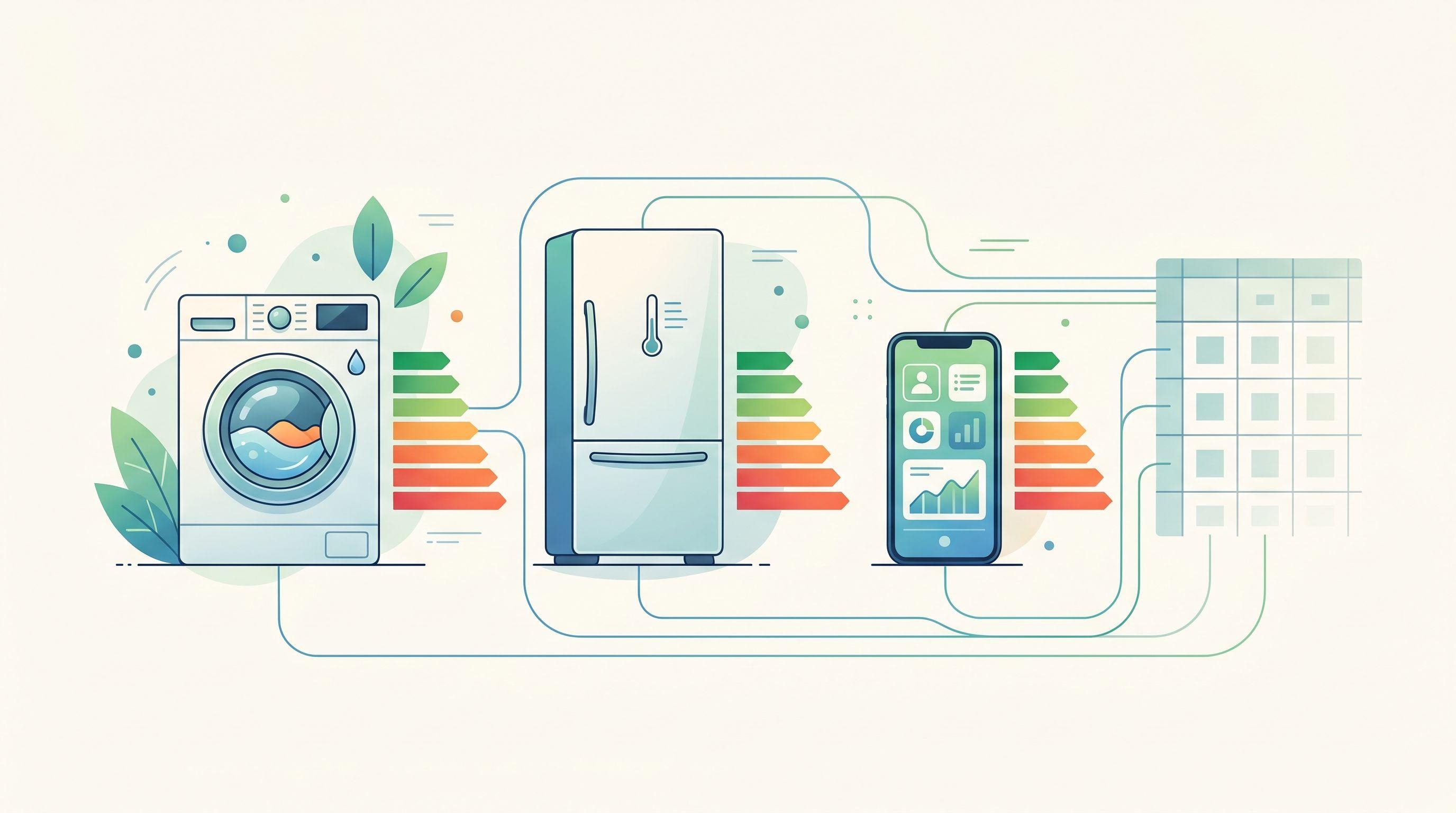
If you sell washing machines, fridges, TVs, lamps, tyres or, since 20 June 2025, smartphones and tablets into Europe, your product feed has to carry energy label data. On 8 April 2025 Google changed how that data travels: for EU-targeted products the old energy_efficiency_class attributes stopped being available, and the EPREL code sent through the certification attribute took over (Search Engine Roundtable, Google Merchant Center Help). The old attributes still work for the UK, Switzerland and Norway. eBay has three routes of its own.
This guide is for feed managers and agencies running one catalog across EU, UK and non-EU markets such as Turkey. By the end you will know which attribute each market and channel expects, how to format it, how to run both in one pipeline, and how to score your feed against a checklist.
The short answer: which energy label attribute goes where
Pick the attribute by target country and channel, not by product. The same washing machine needs one format in its German offer and another in its UK offer.
| Approach | Where it applies | What you send | If it is missing or wrong | When it wins |
|---|---|---|---|---|
Google certification (EPREL) | Products targeting EU countries | Authority EC, name EPREL, code = EPREL registration number | A warning in the Needs attention tab; Google says products are not disapproved for this | Every EU-targeted labelled product. It is the only supported route |
Google energy_efficiency_class + min_ + max_ | Products targeting the UK, Switzerland or Norway | Class letter plus the label's min and max range | Sent for EU targets, it raises the "deprecated energy efficient attributes" issue | UK, CH and NO offers, until Google moves those markets too |
| Google automatic matching | Europe, when you send nothing | Nothing; Google "may" fill it from GTIN and MPN | Unpredictable. You cannot see in advance which items will match | Never as a plan, only as a safety net |
| eBay EPREL item aspect | EU and Switzerland sellers | The EPREL registration number as an item aspect | Listing errors or rejected revisions if the format fails | EU listings where you already hold EPREL numbers |
eBay energyEfficiencyLabel object | EU, UK and Switzerland marketplaces | Label image URL, product information sheet URL, short description | Required documents missing for regulated categories | UK listings, or when you host label images yourself |
How Google's certification attribute works for EU energy labels
The certification attribute is a repeated group with up to four parts. For EU energy labels Google requires three of them: certification_authority set to EC or European_Commission, certification_name set to EPREL, and certification_code set to the model's EPREL registration number. Google then "will use the EPREL code to look up the appropriate energy efficiency label" and shows it on Shopping ads and free listings (Google).
That is the key difference from the old attributes. You send a pointer, not a class letter, and Google pulls the label from the EU database. A wrong number shows a wrong label.
In a CSV or Google Sheets feed, Google's documented header and value look like this:
certification(certification_authority:certification_name:certification_code)EC:EPREL:123456
In XML each certification is a nested group:
<g:certification><g:certification_authority>EC</g:certification_authority><g:certification_name>EPREL</g:certification_name><g:certification_code>123456</g:certification_code></g:certification>The same attribute carries other schemes, including Energy Star for the US and Canada, but Energy Star is no substitute for the EU label (certification spec).
If you push products through the Merchant API rather than a file, the ProductCertification message has the same fields plus two optional ones, certification_document_link and certification_label_link. Google's reference describes them as links "required by UK's DESNZ or EU's EPREL" (Merchant API reference). The UK mention is worth watching, even though the Help Center still sends UK products to the old attributes.
Where to find the EPREL registration number
Every model with an EU energy label must be registered in EPREL before its first unit goes on the EU market, an obligation that has applied since 1 January 2019. The registration is done by the "supplier": the EU-based manufacturer, the authorised representative of a non-EU manufacturer, or the importer (European Commission, suppliers). If you are a retailer, the number comes from your supplier. You do not create it.
There are three practical places to get it, per the Commission's EPREL FAQ:
- The QR code on the label. New-style labels carry a QR code that opens the model's EPREL page. The number at the end of that URL is the code Google wants. Google's own example uses a URL ending in 123456.
- The public EPREL database. You can search it by brand and model identifier for product groups without a QR code.
- Supplier data feeds. Dealers on Tradeplace receive the EPREL number in the PI data standard.
Store the number in its own column, keyed by SKU, in your PIM or a supplementary sheet. Do not rebuild it from the model name: one registration covers one model.
Where energy_efficiency_class still applies: UK, Switzerland and Norway
Since April 2025, Google says energy_efficiency_class, min_energy_efficiency_class and max_energy_efficiency_class "are only available for products that target Switzerland, Norway, or the United Kingdom" (Google). Accepted values are A+++ through G. You must send the min and max with the class, and the class must fall inside that range.
A UK row for a fridge on the rescaled A to G label looks like this:
id: FR-7741-GB | energy_efficiency_class: C | min_energy_efficiency_class: G | max_energy_efficiency_class: AOne edge case catches teams that sell food or detergents alongside appliances. Google says to submit either unit pricing or the energy efficiency class, "not both", and if both are present only the energy class is shown. We cover the unit pricing side of that conflict in our unit_pricing_measure reference.
A worked example: one SKU, three markets
Take one washing machine sold in Germany, the UK and Turkey. Here is the same product as three channel-ready rows. The values are illustrative.
| Field | DE offer (EU) | GB offer | TR offer |
|---|---|---|---|
| id | WM-9K-1400-DE | WM-9K-1400-GB | WM-9K-1400-TR |
| feed_label | DE | GB | TR |
| certification | EC:EPREL:123456 | not sent | not sent |
| energy_efficiency_class | not sent | A | not sent |
| min / max_energy_efficiency_class | not sent | G / A | not sent |
| gtin, mpn | sent | sent | sent |
Why split by feed label rather than send everything everywhere? Google documents each format per target country, but not how one offer targeting both an EU country and the UK is treated when it carries both. Separate offers per market keep the outcome predictable.
Keep GTIN and MPN on every row anyway. Google says that when certification data is missing it "may automatically add it based on GTIN and MPN data" (Google). Clean identifiers make that fallback more likely to work. Our GTIN teardown covers the common identifier failures.
In Feedance, the usual setup is a supplementary feed that maps SKU to EPREL number and UK class, plus feed rules set per channel or export that write the right format and clear the other one. Your source catalog stays unchanged.
What Turkey changes, and what it does not
Turkey has its own Framework Regulation on Energy Labelling, published in the Official Gazette on 2 March 2021 (No. 31411). It defines distance selling to include the internet, and it defines the "product database" as the database created by the European Commission (regulation text). In practice Turkish labels follow the EU design.
Google's energy label documentation only names EU, EFTA and UK markets (Google). Don't expect either attribute to produce a label on a Turkey-targeted offer. Your obligation to show the label near the price on your own site and marketplace listings comes from the Turkish regulation, not from Google. Check it with your legal advisor; this guide is not legal advice.
For Turkish exporters selling into Germany or the Netherlands through Google, the EU offer needs the EPREL code registered by their EU importer or representative.
Correcting the record: is a missing label a disapproval?
Some third-party feed glossaries still describe a missing EU energy label as a critical disapproval and tell you to fix it with energy_efficiency_class. One widely indexed example says exactly that. On both points, Google's current documentation disagrees. For EU targets the fix is certification, and Google says that if you do not provide a supported combination "you'll see a warning in the Needs attention tab" and products "aren't disapproved for this" (Google).
Being listed is a separate question from being compliant. EU rules require online dealers to show the label and product information sheet close to the price, with the arrow in the same font size as the price, on every page where the product appears (European Commission, dealers).
Energy label feed checklist with scoring
Score each item 0 (no), 1 (partly) or 2 (yes). A total of 16 or more out of 20 is a healthy setup. Below 12, fix the first three items before anything else.
- Every SKU in a labelled product group is flagged in the catalog. Use the Commission's product list: ovens, range hoods, dishwashers, washing machines, washer-dryers, tumble dryers, fridges and freezers, air conditioners, heaters, water heaters, ventilation units, displays, smartphones and tablets, light sources and tyres.
- Each flagged SKU has an EPREL registration number stored per model, not per product family.
- EU-targeted offers send
certificationasEC:EPREL:<number>and noenergy_efficiency_class. - UK, CH and NO offers send class, min and max, with the class inside the range.
- No offer sends both unit pricing and an energy class.
- GTIN and MPN are valid on every labelled SKU, so Google's automatic matching can act as a fallback.
- The Needs attention tab shows zero certification and deprecated-attribute warnings for the EU feed labels.
- Smartphones and tablets sold in the EU since 20 June 2025 have EPREL numbers. Their label also covers battery endurance, drop reliability and a repairability class (European Commission).
- eBay EU listings carry the EPREL aspect, or the label image and information sheet URLs, with images at least 500 px on the longest side (eBay).
- Your own product pages show the label and information sheet near the price, so ads and landing pages say the same thing.
What this guide doesn't cover, and where the method breaks down
We have not covered how Meta, TikTok or Amazon handle energy labels. We could not find a documented energy label field in Meta's catalog specification during research, but absence from search is not proof. Check the current spec before assuming a channel ignores it.
The per-market split assumes you can create separate offers per country. If you cannot, the safest single setup is certification on every labelled row, with UK class attributes added only through a UK-specific supplemental source.
Google publishes no match rates for its GTIN-based automatic matching, so treat it as a fallback. If most of your EU revenue comes through German and Dutch marketplaces rather than Google and Meta, tools built in those markets, such as Channable or Productsup, may already ship marketplace-specific label templates. Compare template lists before you build rules by hand.
Frequently asked questions
Is energy_efficiency_class still supported in Google Merchant Center?
Yes, but only for products that target the United Kingdom, Switzerland or Norway. Since April 2025, products targeting EU countries should use the certification attribute with an EPREL code instead. Sending the old attributes for EU targets raises a deprecated-attributes issue.
What values do I put in the certification attribute for an EU energy label?
Set certification_authority to EC or European_Commission, certification_name to EPREL, and certification_code to the model's EPREL registration number. In a CSV feed that reads EC:EPREL:123456 under the header certification(certification_authority:certification_name:certification_code).
Will my products be disapproved if the EPREL code is missing?
According to Google's certification specification, no. A missing or unsupported combination shows a warning in the Needs attention tab. Your legal obligation to display the label still applies.
Where do I find a product's EPREL registration number?
Scan the QR code on the energy label. The number at the end of the EPREL URL it opens is the code. You can also search the public EPREL database, or ask your supplier, who registered the model before putting it on the EU market.
Does Google show energy labels on Shopping ads in Turkey?
Google's energy label documentation names only EU, EFTA and UK markets, so do not expect a label badge on Turkey-targeted offers. Turkey's own energy labelling regulation still governs what you must show on your site and marketplace listings.
How does eBay handle EU energy labels?
eBay accepts an EPREL registration number as an item aspect for EU and Switzerland sellers. It also accepts an energyEfficiencyLabel object with label image and product information sheet URLs, or documents uploaded through its Media API.
Check your feed before your next EU launch
Missing identifiers, mixed attribute formats and empty columns are the problems that let energy label data drift. Run your feed through the free product feed audit tool to see your completeness and quality gaps before they turn into Merchant Center warnings.
Sources
- Google Merchant Center Help: Certification [certification]
- Google Merchant Center Help: Best practices for EU Energy Labeling (EPREL)
- Google Merchant Center Help: Energy efficiency class, min and max attributes
- Google Merchant Center Help: How to fix deprecated energy efficient attributes
- Google Merchant API reference: ProductCertification
- Search Engine Roundtable, 9 April 2025: Google updates Merchant Center product specifications
- PPC Land, 13 April 2025: Merchant Center product data specification changes for 2025
- European Commission: What do suppliers need to know?
- European Commission: What do dealers need to know?
- European Commission: What is the EPREL registration number and where can I find it?
- European Commission: Product list
- European Commission: Smartphones and tablets
- eBay Developers: Energy efficiency
- Enerji Etiketlemesi Çerçeve Yönetmeliği, Resmî Gazete 2 March 2021, No. 31411 (full text)
- GoDataFeed: Missing EU energy efficiency label (cited as the claim being corrected)

Co-founder of Feedance, where she draws on 20+ years in product and user experience design to shape how catalogs become creative. With a strong focus on bridging design systems and automation, she is dedicated to helping brands scale visual quality without scaling design effort.
LinkedIn